


Deadwood Rye Review
Deadwood Rye ReviewWhere to buy Deadwood Rye — compare online retailers and find local stores near you.
WHERE TO BUY — ONLINE & LOCAL
Quick Facts
Is This For Me?
You want the classic MGP dill-and-pepper rye signature for roughly twenty dollars; you mix more than you sip and want a bottle you can pour freely into Sazeracs and Old Fashioneds; or you like that the bottler tells you plainly on the label that the whiskey is sourced rather than pretending otherwise.
You want a neat pour. "Thin," "watery" and "very little body" recur across our reviewers, and at 83 proof there is not much backbone. Several found it flatly too young — "much too young and unpolished" in one verdict — and one blind taster placed it below a standard bourbon.
Flavor Profile at a Glance
What It Tastes Like
Nose
Oak and fresh-sawn wood first, then cereal grain and rye bread, with dill running straight through the middle and a cool menthol-and-mint lift above it. Anise and clove sit behind, alongside pear and orchard fruit.
Palate
Heavy rye spice and black pepper over brown sugar sweetness, with vanilla and honey underneath and a clear charred wood note. Thin and watery in texture — the flavours are louder than the body carrying them.
Finish
Cinnamon that starts as Red Hots candy, then more black pepper and raw charred wood over a dry, tannic fade. Length divides our reviewers three ways, from short to long.
Best Ways to Enjoy
Neat
The weakest case. Low heat makes it easy enough to drink, but the body is thin and the young, grainy edge has nowhere to hide.
With Water
Don't. At 41.5% there is no heat to tame and reviewers who tried it found it simply washed the whiskey out.
On Ice
Better than water. Chill mutes the raw wood and pushes the dill and pepper forward, which is where this bottle is most interesting.
Cocktail
The reason to buy it. Every reviewer who reached a recommendation reached this one — it is a mixing rye, priced like one.
Cocktail Scores
Price & Value
This is the argument for the bottle, and it is a decent one. Twenty-odd dollars buys you genuine MGP 95/5 rye — the same distillate underneath a great many bottles costing two and three times as much — with no craft-distillery markup and no pretence. What you do not get is time in wood, and it shows: every criticism in our source pool traces back to youth rather than to anything wrong with the liquid.
If you want the same profile with more years behind it, Bulleit 95 Rye is the obvious step up for a few dollars more. And if cheap-and-mixable is the whole brief, the rest of that field sits in our budget rye whiskey under $24 collection.
Bottle Transparency
- DistilleryNot the brand. The label says "Distilled in Indiana and Tennessee," which reviewers read as MGP of Indiana and George Dickel — and Dickel's rye is itself MGP stock. Deadwood is a sourced whiskey and does not claim otherwise.
- BottlerProof and Wood Ventures, founded by Dave Schmier — the same person behind Redemption Rye before that brand was sold. Blended and bottled in Kentucky. Front label reads "Sourced Small Batch."
- Mash billsTwo, blended: 95% rye / 5% malted barley from Indiana, and 70% rye / 30% corn from Tennessee. The ratio between them is not published, so the finished blend's rye percentage is unknown.
- Maturation"Carefully aged in full-size American oak barrels at least 24 months," per the back label — full 53-gallon barrels, not the small casks common at this price. Earlier 2018 bottlings stated 13 months and 81 proof; the current bottle is the longer-aged one.
- FiltrationThe Tennessee component is charcoal-mellowed through the Lincoln County Process before barrelling. No filtration statement is published for the finished blend.
- LabellingThe word "straight" is conspicuously absent even though the stated age clears the two-year requirement. The brand has never explained why. Worth knowing before you assume it is a straight rye.
Full Review: Deadwood Rye
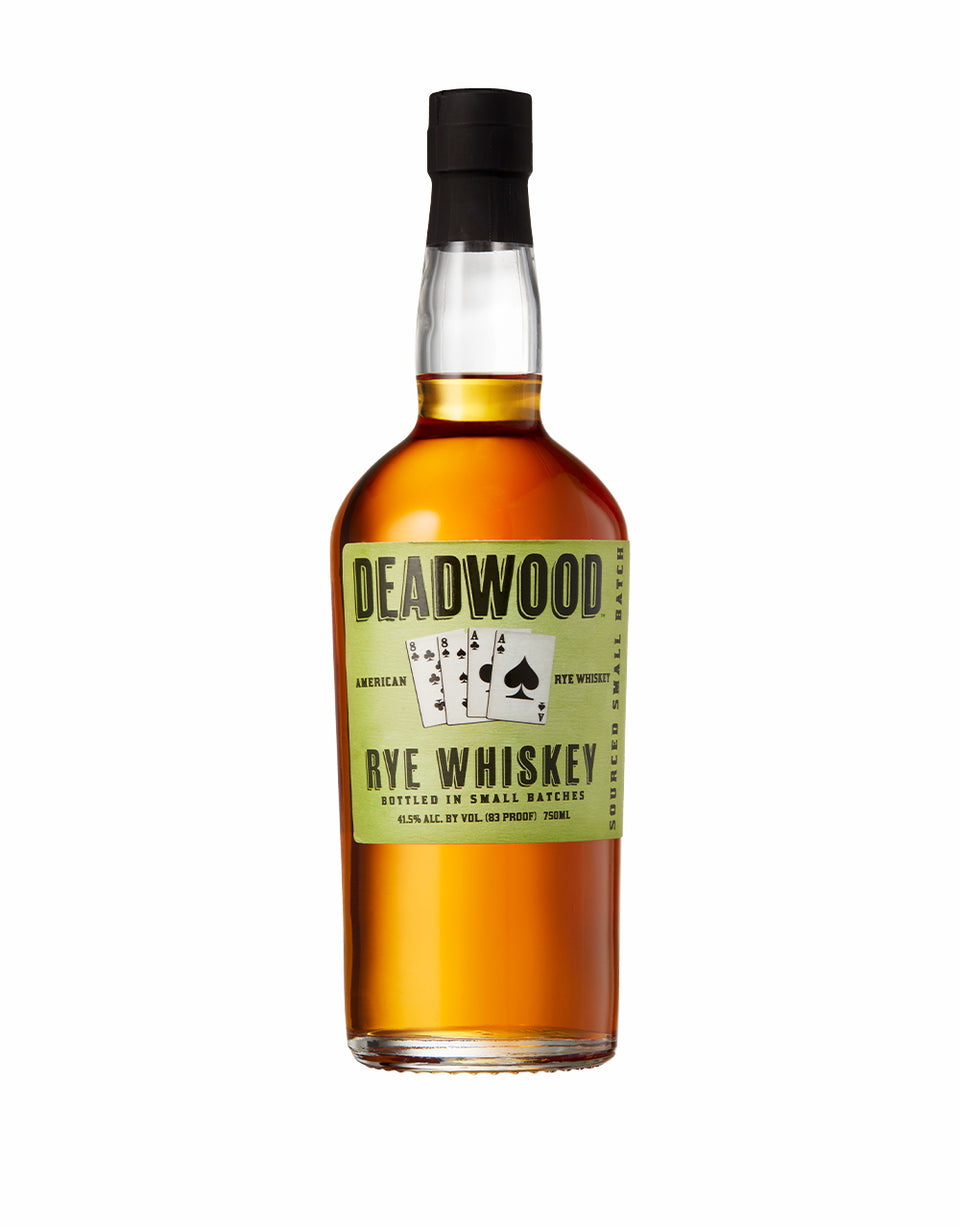
The most interesting thing about Deadwood Rye is not in the glass. It is that a bottle this cheap tells you more about where its whiskey came from than most bottles costing five times as much. Dave Schmier built Redemption into one of the brands that started the modern rye revival, sold it, and started again as Proof and Wood Ventures — an operation so low-key that when Drinkhacker reviewed this range in 2019 they noted the company did not have a website. It still barely does: at the time of writing, proofandwood.com has a page for Deadwood Bourbon and no page at all for the rye.
Who Actually Makes It
The label says "Distilled in Indiana and Tennessee." In practice that means MGP in Lawrenceburg and George Dickel in Tullahoma — and, as one reviewer who read the bottle carefully pointed out, Dickel does not distil its own rye either, so the Tennessee portion is MGP spirit that has been run through the Lincoln County Process on its way to the barrel. What you are drinking, then, is MGP rye twice over: the familiar 95% rye / 5% malted barley recipe blended with a softer 70% rye / 30% corn mash. The blend ratio is the one thing Proof and Wood does not disclose. Everything else — the two mash bills, both states, the full-size 53-gallon barrels, the twenty-four-month minimum — is printed on the bottle.
That matters because the alternative, at this price, is silence. Plenty of budget ryes list a PO box and a mash bill and leave you to guess. Deadwood gives you enough to work out the supply chain yourself, and the brand's own marketing leans on Wild Bill Hickok and the dead man's hand rather than on invented distilling heritage. For a sourced whiskey, that is about as straight as the category gets. The comparable honesty play on a Canadian shelf is Canadian Club 100% Rye, which is similarly upfront and similarly cheap.
Dill, And Then More Dill
The MGP 95/5 signature arrives on schedule. Dill is the single most consistent descriptor across our sources — The Whiskey Jug calls it "a punch of dill" on the nose and "an even bigger dill punch" on the palate, Whiskeyfellow describes dill running across the tongue on the inhale, and Bottle Raiders files dill among the bottle's defining notes. Around it sit anise, clove, menthol and mint, and a surprising amount of light fruit: pear, apple, melon, orchard fruit, even honeydew. That fruitiness is a genuinely young-whiskey trait. Oak and spirit have not had time to make dark fruit yet, so you get orchard instead.
Where the reviewers part company is on how much of that is a good thing. Distiller's Jacob Grier found "an approachable, summery rye, ideal for those seeking a lighter American whiskey." Drinkhacker found it "overwhelming with heavy, heavy spice elements and red pepper" and concluded it was "simply much too young and unpolished." Bottle Raiders' in-house critic, tasting blind, guessed it was a low-grade bourbon and judged it fit for the rail. Those are three people describing the same liquid, and the gap between them is the single most useful thing to know before you buy: there is no consensus that this is good, only a consensus about what it is.
The Body Problem
What our sources do agree on is texture. "Med-light body and a light watery feel." "Thin palate, no heat. Very little body." "Thin and watery." Three independent reviewers reach for almost the same word. At 41.5% ABV there is not much to push the flavours along, and the effect is of a whiskey whose spice arrives loudly and then has nothing behind it. Drinkhacker is the lone dissenter, finding a "brown butter body" and a long, rolling finish — which is part of why finish length splits three ways across the pool and why we have called it a 5 rather than picking a side.
Set against a shelf-standard cheap rye this is the honest comparison: Rittenhouse Bottled-in-Bond costs a few dollars more, carries a legally guaranteed four years and 100 proof, and solves the exact problem Deadwood has. If you are choosing between them for a cocktail cabinet, that is a hard case to argue against.
Our Verdict
A cheap, young, genuinely transparent sourced rye that does one job well and should not be asked to do any other. Buy it to mix — it is more than good enough for a Sazerac or an Old Fashioned, and the dill-and-pepper profile earns its place in a drink. Do not buy it to sip, and do not expect the transparency to translate into quality: knowing exactly where a two-year-old whiskey came from does not make it older. See where it sits against the field in our best rye whiskeys for cocktails guide.
One shelf warning. Proof and Wood put out several things that look alike and are not: Deadwood Bourbon (an 81-proof bourbon, not a rye), Deadwood Presents Tumblin' Dice (a high-rye bourbon, usually barrel proof), and Roulette Rye (a separate rye brand from the same bottler). Reviews of those bottles say nothing about this one, and we have kept them out of the figures below.
Community Tasting Notes
Be careful with this number. It rests on just nine independent scored sources and roughly fourteen named crowd ratings in total — the thinnest pool we have published. Drop the harshest reviewer and it rises to about 2.8; drop the most generous and it falls to about 2.6, so the figure is stable but it is built on very little. Almost every scored review we could find dates from 2018 to 2020, and there is essentially no recent coverage of this bottle at all.
Top Reported Flavors
Rating Distribution
🎁 Whiskey Review Rewards
$10 Gift Voucher — Every Review
Write a real tasting review and we'll send you a $10 digital gift voucher for barware and whiskey accessories on the store. Your honest notes help fellow rye lovers discover new favorites.
"At RyeCentral, we never pay for positive reviews — honest, unbiased opinions matter."
Pros & Cons
Pros
- Real MGP 95/5 rye character for roughly twenty dollars
- Unusually honest labelling — both mash bills, both states and the age are printed on the bottle
- Aged in full-size 53-gallon barrels, not the small casks common at this price
- Textbook dill-and-pepper rye signature that survives being mixed
- Widely recommended for Sazeracs and Old Fashioneds by the reviewers who liked it
- Low heat — easy to drink even if it is not especially rewarding
Cons
- Thin body — "watery," "light" and "very little body" recur across three reviewers
- Reads young and unpolished; raw charred-wood and grain notes are not hidden
- 83 proof leaves it underpowered in anything assertive
- Not labelled "straight" despite clearing the age requirement, with no explanation given
- The blend ratio between the two mash bills is not disclosed
- Very little published coverage, almost all of it five or more years old
Frequently Asked Questions
❓ Who actually distils Deadwood Rye?
❓ What is the Deadwood Rye mash bill?
❓ How old is Deadwood Rye?
❓ What proof is Deadwood Rye?
❓ Is Deadwood Rye a straight rye whiskey?
❓ Is Deadwood Rye good in cocktails?
❓ How is Deadwood Rye different from Roulette Rye or Deadwood Bourbon?

Quality You Can Trust

RyeCentral Lab
Tasted it? Get ranked for it.
Every review earns Lab points — climb the ladder from All Rye to Rye Legend. Your first review earns 100 points and $10 store credit — five stars or one.